
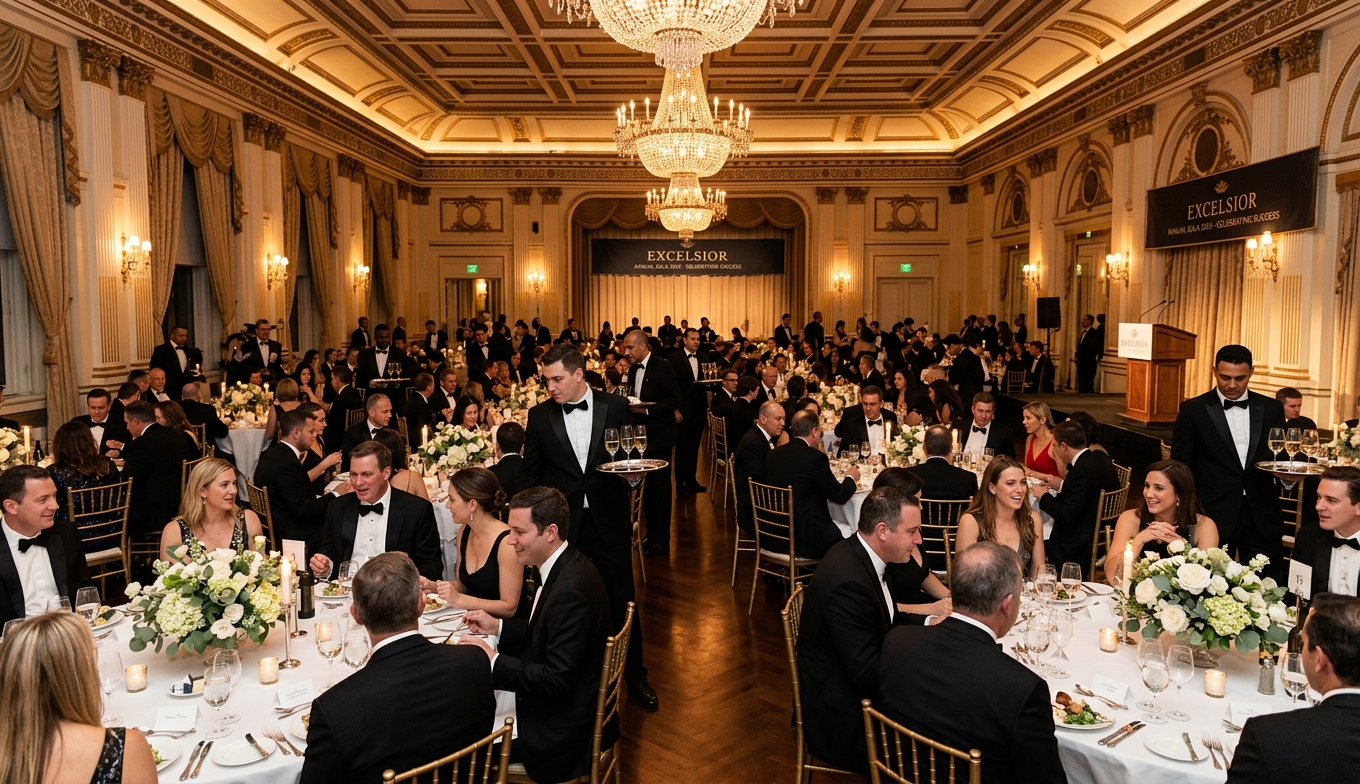
Corporate Gala Staffing: Everything You Need for a Flawless Black-Tie Event...
A corporate gala is the highest-stakes event most planners produce. The guest list is senior. The brand exposure is significant. The expectations are unspoken but absolute — and the margin for error is zero.
Every detail has been curated: the venue, the florals, the menu, the entertainment. The one variable that can unravel all of it in the first thirty minutes is the wrong staffing team.
At the gala level, service is not a support function. It is the experience. The way guests are greeted at arrival, how quickly champagne appears in their hands, whether courses land simultaneously or stagger awkwardly across the room — these are the moments that define how the evening is remembered and how your organization is perceived.
This guide covers everything a corporate event planner needs to know about staffing a black-tie gala: the roles required, the ratios that work, the standards that matter, and the timeline that gives your event the team it deserves.
What Makes Gala Staffing Different from Any Other Corporate Event...
Most corporate events require competent, professional staff. A gala requires something more specific: staff who are trained in the discipline of formal service — and who understand that at this level, the goal is to be invisible.
The best gala service staff are present everywhere and noticed nowhere. Glasses are refilled before a guest thinks to ask. A dietary restriction is accommodated without drawing attention to the table. A course lands at every seat in the room within moments of the first plate — not because one server raced to catch up, but because every server moved on cue.
This is what separates gala staffing from general event staffing. It is not just about having enough people on the floor. It is about having the right people, trained in formal service protocol, managed by an experienced captain who runs the floor like a conductor, and briefed thoroughly enough that every service moment unfolds exactly as planned.
The stakes are also different. At a corporate gala, your guests are typically executives, board members, major clients, and senior stakeholders. A service failure in this room is not just an inconvenient evening — it reflects on your organization’s attention to detail, your brand’s standards, and the relationships you’re trying to strengthen or build.
The Complete Gala Staffing Breakdown: Every Role You Need.
A corporate gala requires more role types than most events. Here is every position your staffing plan should account for — and what each one actually does.
Registration and Greeter Staff:
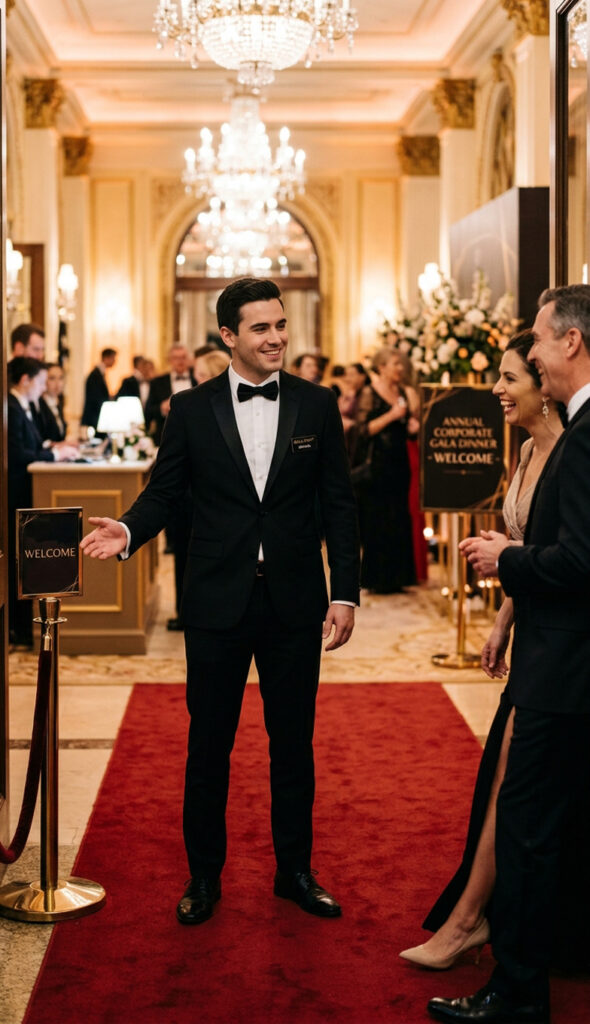
The first impression your guests have of the evening is formed before they reach the ballroom. Registration and greeter staff manage the arrival experience: welcoming guests by name when possible, directing them efficiently, managing escort cards and seating charts, and handling the inevitable last-minute guest list questions without disruption. Plan for 1 greeter per 75 guests at peak arrival time.
Coat Check Attendants:
For formal South Florida events held in hotel ballrooms or venues with air conditioning, coat check is often expected. A coat check team that is slow, disorganized, or understaffed creates a visible bottleneck at arrival and a frustrating delay at departure — both in front of your most important guests. Plan for 1 attendant per 75–100 guests, with two as a minimum for any event over 100 people.
Cocktail Reception Servers:
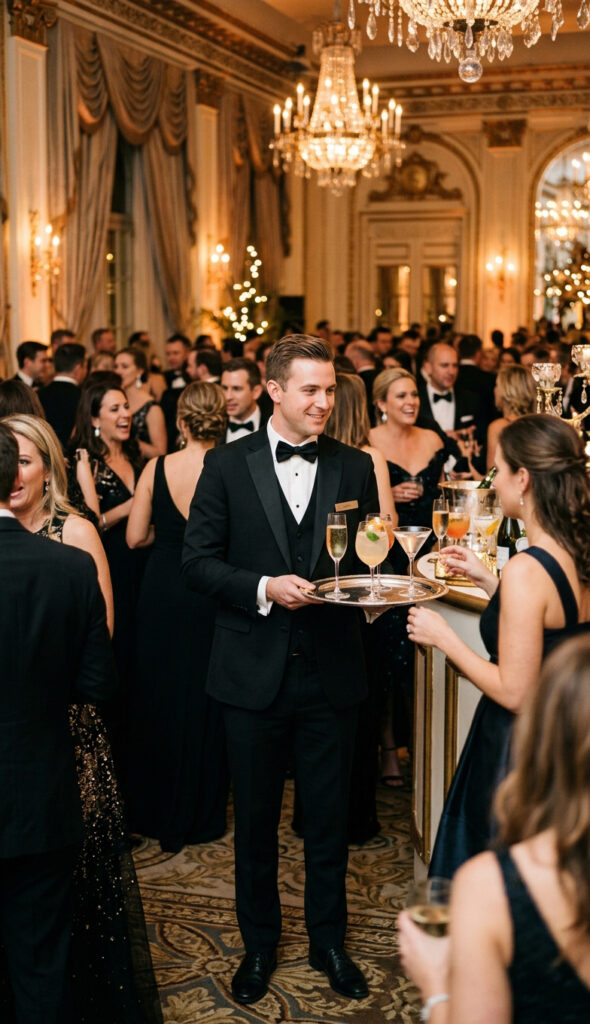
The cocktail hour is where your gala begins in the minds of your guests. Passed hors d’oeuvres should circulate continuously, champagne should feel effortless, and the bar should never produce a line longer than two or three people. Plan for 1 passed-appetizer server per 25 guests during this window, and staff the bar at 1 bartender per 40–50 guests — this is your highest-demand period of the evening.
Formal Dinner Servers:
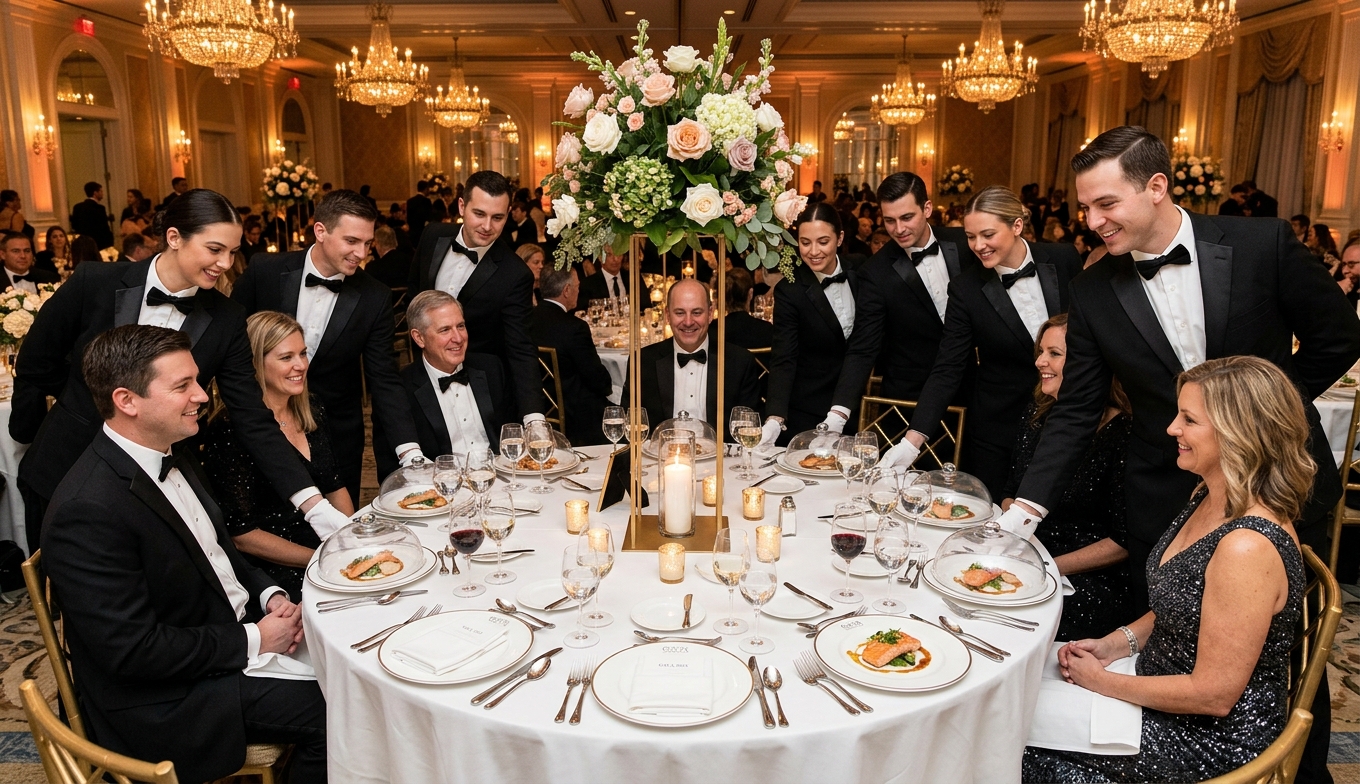
For plated gala service, the standard is 1 server per 10 guests. For VIP tables or head-table service, tighten to 1 server per 6–8 guests. Gala servers must be trained in formal service protocol: plates land simultaneously, wine is poured on the right, water is maintained throughout, and no server ever reaches across a guest. These are not optional niceties at a black-tie event — they are the standard your guests expect.
Bussers and Support Staff:
1 busser per 3 servers keeps the floor clean and allows servers to focus on guest-facing service rather than clearing plates. At a gala, a cluttered or poorly bussed table signals a loss of control — and guests notice.
Bartenders:
For a full open bar during dinner service, maintain 1 bartender per 50 guests. If your gala includes a signature cocktail, specialty wine service, or a champagne toast pour, plan for additional coverage during those specific moments.
Event Captains:
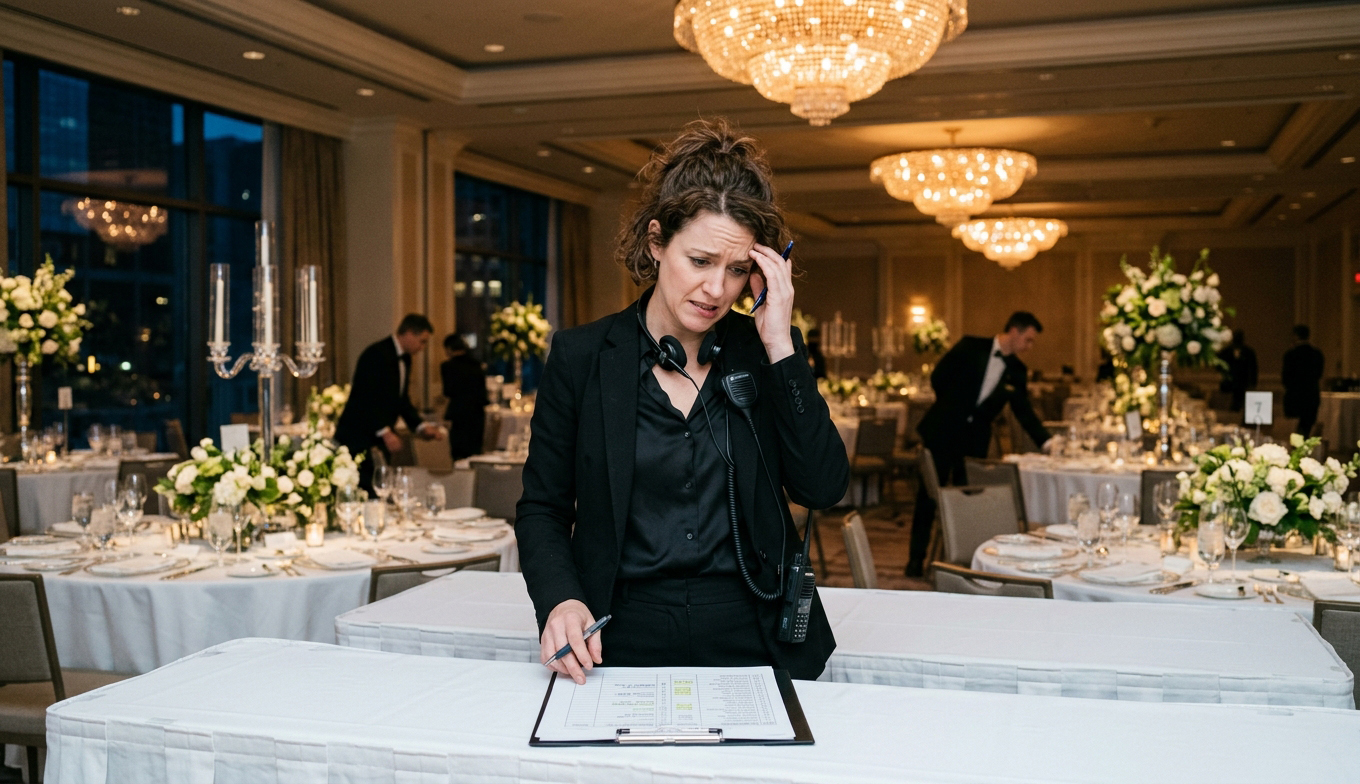
The captain is the most important hire on your gala floor. Plan for 1 experienced captain per 100 guests — for a 300-person gala, that means 3 captains. Each captain manages a section of the room, coordinates course timing with the kitchen, monitors the floor for service gaps, and handles any issue before it reaches a guest. A gala without a strong captain structure is a gala running on luck.
VIP Escort and Personal Attendant Staff:
If your gala includes a separate VIP reception, head table protocol, or specific guests requiring dedicated attention — keynote speakers, board members, major donors, or C-suite executives — assign dedicated personal attendants to those individuals. These staff members are not pulled from the general floor when needed. They are positioned and briefed specifically for those guests from the start of the evening.
Sample staffing plan — 300-person corporate gala with plated dinner and full open bar:
– 4 registration / greeter staff
– 2 coat check attendants
– 12 cocktail hour servers (passed appetizers)
– 8 bartenders (cocktail hour and dinner combined)
– 30 dinner servers
– 10 bussers
– 3 event captains
– 2 VIP personal attendants
Total: approximately 71 team members
For a full breakdown of staffing ratios across event types, see our complete event staffing guide.
For the complete event staffing guide” → Click Here
The Standard That Separates Gala Service from Everything Else.
At a corporate gala, service standards extend well beyond technical skill. Every placed staff member is a direct reflection of your brand and your organization — from the moment they step on the floor to the moment the last guest departs.
Appearance and presentation. Gala service staff should arrive in impeccable, formal attire — pressed black-tie uniforms, clean and polished footwear, minimal accessories, and grooming standards that hold up under a chandelier. A staff member whose appearance falls short in this environment creates a visible inconsistency against a room where every other detail has been carefully curated. This standard is set at briefing and confirmed at check-in. A professional agency doesn’t leave it to chance.
Formal service protocol. Synchronized plated service — where every guest at every table receives their course within moments of each other — is a technique that requires rehearsal, communication, and an experienced captain calling the pace. Wine is poured from the right. Water glasses are monitored and refilled without being asked. Dietary accommodations are handled discreetly and without drawing attention to the guest. These are the behaviors that define formal service, and they don’t happen without both training and strong on-site leadership.
Invisible problem-solving. Things go wrong at every event. At a gala, the measure of your staffing team is whether your guests ever know it. A dropped plate, a dietary request not communicated to the kitchen, a missing place card — a professional team handles each of these quietly, quickly, and completely out of guest view. This is what experienced captains and well-briefed staff actually deliver.
Guest discretion. At the executive level, guests expect staff who are warm but not familiar, helpful but not intrusive, present but not hovering. This calibration — the judgment to know when a guest needs something and when to step back — is a quality that separates hospitality professionals from people who are technically filling a role.
Managing the Gala Timeline: The Service Moments That Require the Most Planning.
A corporate gala is not one sustained service experience. It is a sequence of distinct moments, each with its own staffing demand — and each representing a point where underprepared teams fall apart.
Arrival and registration. The first 30–45 minutes of a gala is the highest-stress window for your front-of-house staff. Guests arrive in clusters, lines form quickly, and the first impression of the evening is set. Your registration team needs to be fast, warm, and able to handle name variations, plus-ones, last-minute substitutions, and guest list questions without slowing the line. Assign a captain specifically to this zone until the arrival surge passes.
Cocktail hour transition. As guests move from cocktail hour into the main ballroom, your staffing team is resetting the floor, clearing cocktail stations, taking positions at tables, and preparing for dinner service — all simultaneously. This transition is where poorly coordinated teams create gaps. A well-briefed team executes it invisibly because every person knows exactly where to be and when.
Synchronized first course. The first plated course is the opening statement of your dinner service. It tells every guest in the room whether the evening is going to feel seamless or not. All tables in a section should receive their first course within the same 60-90 second window. This requires a captain calling the pace and servers moving in coordination — not independently.
Program moments: awards, speeches, and the champagne toast. These are the high-intensity surge moments in a gala’s timeline. When an award is announced, applause fills the room — and your service team needs to be positioned to begin the champagne pour the moment the program cues them, not scrambling to find bottles. The toast pour for 300 guests, executed well, requires pre-positioned servers at every table, a signal from the captain, and a practiced pace. Pre-brief this moment specifically, not as part of the general dinner briefing.
Dessert and departure. The end of the evening is where underperforming teams visibly lose steam — service slows, staff begin to disengage, and the floor falls behind. A professional gala team maintains the same standard through dessert and coffee service as they maintained through the first course. Departure should be as polished as arrival: coat check running efficiently, greeters positioned at exits, and staff remaining attentive until the last guest leaves.
When to Book Your Corporate Gala Staffing Team.
October through December is South Florida’s peak season for corporate galas — which is precisely when the competition for experienced hospitality professionals is at its highest.
The best gala-experienced servers, captains, and formal service staff in South Florida are not available in unlimited supply. They commit to their best clients early, and they book out. A staffing agency that can confirm your full team in the first week of November has either started their planning process months ago or is placing staff with less experience than they’re letting on.
Book your staffing team 10–12 weeks before your gala. For a December event, that means initiating the conversation in September. For an October or November event, August is the right time to begin. This timeline gives your agency the lead time to match the right professionals to your specific event, complete thorough pre-event briefings, and have a confirmed backup plan in place.
Share your run-of-show early. The more detail your staffing agency has about your event — the venue floor plan, the dinner timeline, the program sequence, any VIP protocols, the dress code standard — the better they can prepare your team. Agencies that don’t ask for this information before confirming your team are not building a plan. They are booking a roster.
At Noble LG, we’ve staffed galas for some of South Florida’s most demanding clients — including luxury brand events for names like Chanel and Tiffany & Co. We know what this level of service requires, and we build our staffing plans around your specific event from the first conversation.
Ready to Build Your Gala Staffing Plan?
A corporate gala demands a staffing team that has done this before — at this level, in this market, with these expectations. Noble LG has been staffing South Florida’s highest-profile events for years, and we bring that experience to every engagement, regardless of size.
If your gala is on the calendar and you’re ready to build a staffing plan that matches the standard of your event, let’s talk. We’ll walk through your run-of-show, confirm your headcount, and build a team that makes your evening feel exactly the way you planned it.
Contact Noble LG to start your gala staffing conversation today.
Questions?
Q: What makes corporate gala staffing different from regular event staffing?
A: Gala staffing requires staff trained in formal service protocol — synchronized plated service, wine etiquette, guest discretion, and appearance standards appropriate for a black-tie environment. It also requires experienced captains who manage the floor proactively, and a pre-event briefing process rigorous enough that every service moment unfolds on cue. At the gala level, the goal is not just competent service — it is invisible, flawless service.
Q: How many staff do I need for a 300-person corporate gala?
A: A 300-person gala with plated dinner service and a full open bar typically requires approximately 4 registration staff, 2 coat check attendants, 12 cocktail hour servers, 8 bartenders, 30 dinner servers, 10 bussers, 3 event captains, and 2 VIP personal attendants — approximately 71 team members in total. The exact number depends on your venue layout, service style, program complexity, and VIP requirements.
Q: Do gala staff need special training or experience?
A: Yes. Gala staffing requires demonstrated experience with formal service — synchronized plated service, multi-course timing, wine service protocol, and the ability to handle VIP-level guest interactions with discretion and professionalism. When selecting a staffing agency, ask specifically whether their staff have prior black-tie or gala experience, and request references from similar events.
Q: How far in advance should I book staff for a corporate gala in South Florida?
A: Book 10–12 weeks in advance for galas during peak season — October through December in South Florida. The most experienced formal service professionals in the market commit to their best clients early. Waiting until 4–6 weeks before your event significantly limits your options, particularly for experienced captains and trained formal service staff.
Q: What is the role of a staffing captain at a corporate gala?
A: A staffing captain manages the service team on the floor — directing servers, coordinating synchronized course timing with the kitchen, monitoring the room for service gaps, and handling any issue before it reaches a guest. For galas, plan for 1 experienced captain per 100 guests. A captain is not a luxury at this level — they are the reason the evening runs the way it was planned.
"Success is when every detail works together to create a moment no one wants to end."
Noble Tweet