
You’ve spent months getting every detail right — the venue, the flowers, the menu, the music. The one thing couples most often overlook until it’s almost too late? The team that actually delivers all of it to your guests.
Wedding reception staffing is not a line item to minimize. It is the invisible infrastructure that determines whether your guests feel celebrated or overlooked, whether dinner flows beautifully or lands cold, and whether your bar line is two people deep or twenty.
This guide gives you the exact numbers you need — servers, bartenders, bussers, and coordinators — along with the questions nobody thinks to ask until the morning of the wedding.
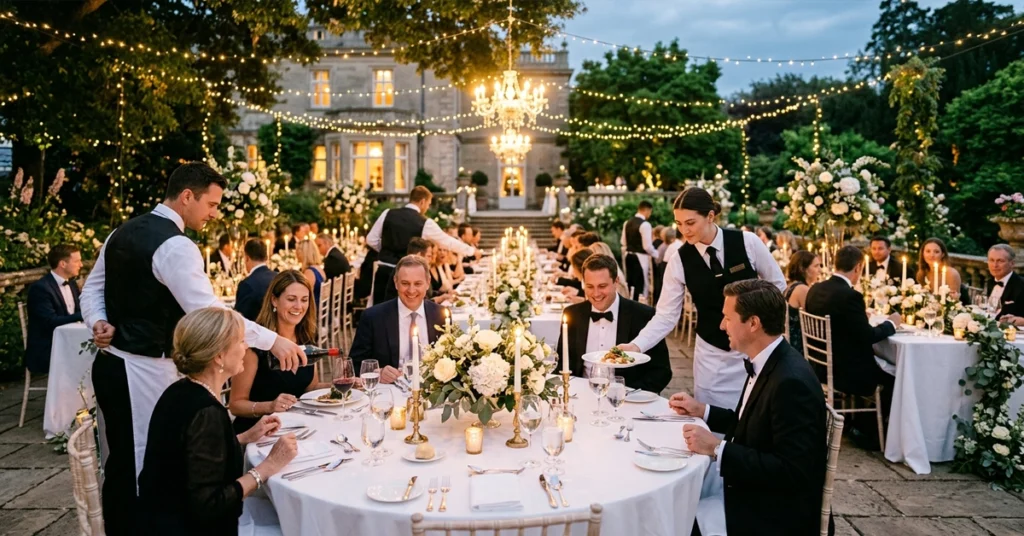
Start Here: The One Variable That Changes Everything...
Before any staffing number makes sense, you need to know your service style. This single decision — more than your guest count, your venue, or your budget — determines how many people you need on the floor.
Plated (sit-down) dinner is the most staff-intensive format and the gold standard for formal receptions. Every course is brought to the table, timed so that all guests at a table are served within moments of each other. This synchronized precision requires more servers — but it creates an experience that guests remember.
Buffet service requires fewer servers on the floor but more support behind the scenes: runners to restock stations, staff to monitor presentation, and bussers to clear plates continuously. Couples often assume buffet means minimal staffing. It doesn’t — it just moves the labor from tableside to stations and back-of-house.
Cocktail-style reception with passed appetizers is the most fluid format but still requires dedicated servers circulating the floor, bar staff handling a constant stream of drink orders, and someone managing the overall flow of the room.
Once you know your service style, you can build an accurate staffing plan. Until then, any number you’re given is a guess.
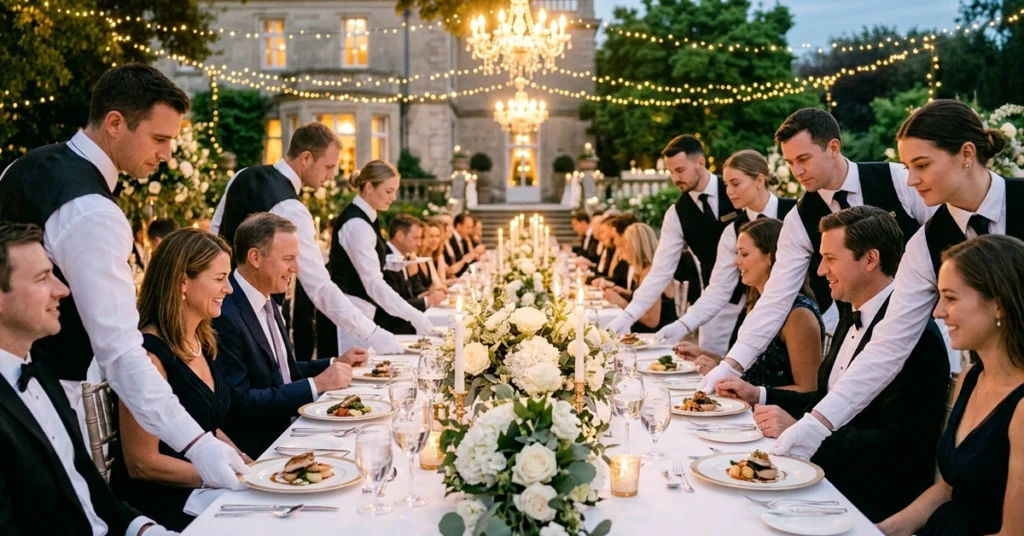
Wedding Reception Staffing Ratios: The Numbers You Need...
Use these as your baseline. Every reception has variables — venue layout, event duration, service complexity — that will adjust the final number. But these ratios are where every professional staffing plan starts.
Servers
– Plated dinner: 1 server per 10–12 guests
– Buffet service: 1 server per 20–25 guests
– Cocktail-style (passed appetizers): 1 server per 25 guests.
Bussers
– 1 busser per 3 servers, regardless of service style
– Bussers are often the difference between a reception that looks polished all evening and one that starts to fall apart after the first course.
Bartenders
– Beer and wine only: 1 bartender per 75 guests
– Full open bar (beer, wine, spirits): 1 bartender per 50 guests
– Full bar with signature cocktails or blended drinks: 1 bartender per 35 guests
– Add 1 bar-back for every 2–3 bartenders to manage ice, glassware, and restocking.
Event captain / staffing floor manager
– 1 captain per 75–100 guests
– The captain manages your service team, coordinates course timing, and handles anything that comes up on the floor — so you don’t have to.
Greeter / registration staff
– 1 per 75 guests at peak arrival time
– Essential for formal receptions with escort cards, seating charts, or gift table management.
Sample plans by guest count:
For a 100-person plated dinner with full open bar:
10 servers · 3 bussers · 2–3 bartenders · 1 event captain = approximately 16–17 team members.
For a 200-person plated dinner with full open bar and signature cocktails:
18–20 servers · 6 bussers · 5–6 bartenders · 2 event captains · 2 greeters = approximately 33–36 team members.
For a 300-person plated dinner with full open bar and signature cocktails:
28–30 servers · 10 bussers · 8–9 bartenders · 3 event captains · 4 greeters = approximately 53–56 team members.
For a full breakdown by event type — including corporate and cocktail receptions — see our complete event staffing guide.
“Complete event staffing guide” → Here
The Cocktail Hour Problem Nobody Warns You About...
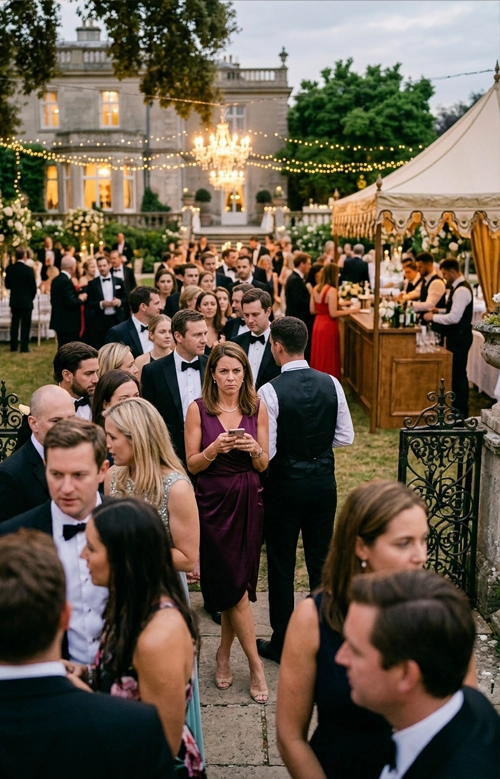
Cocktail hour creates the highest bar demand of your entire reception — and it happens in the first 30 minutes. Every guest arrives at once, and they all want a drink in hand before anything else.
This is the window that breaks underfunded bar setups. If you planned 1 bartender per 75 guests assuming a steady flow throughout the night, you will have a 20-minute bar line during cocktail hour — because the load is not steady. It is compressed into one overwhelming arrival surge.
There are two ways to solve this.
Staff for your peak, not your average. Your bartender count should be based on what cocktail hour demands, not what the full evening average suggests. For a full open bar, that means 1 per 40–50 guests during that first hour, even if you adjust coverage after dinner begins and bar traffic slows.
Split your bar. Instead of one bar for 200 guests, two smaller stations for 100 guests each move far more efficiently — guests don’t have to cross the room for a drink, the bartender has fewer bodies to manage at once, and the line perception drops significantly even if total volume is the same.
Your staffing agency should be asking about your cocktail hour setup when planning your bar coverage. If they’re not, that’s a gap in their planning process worth raising.
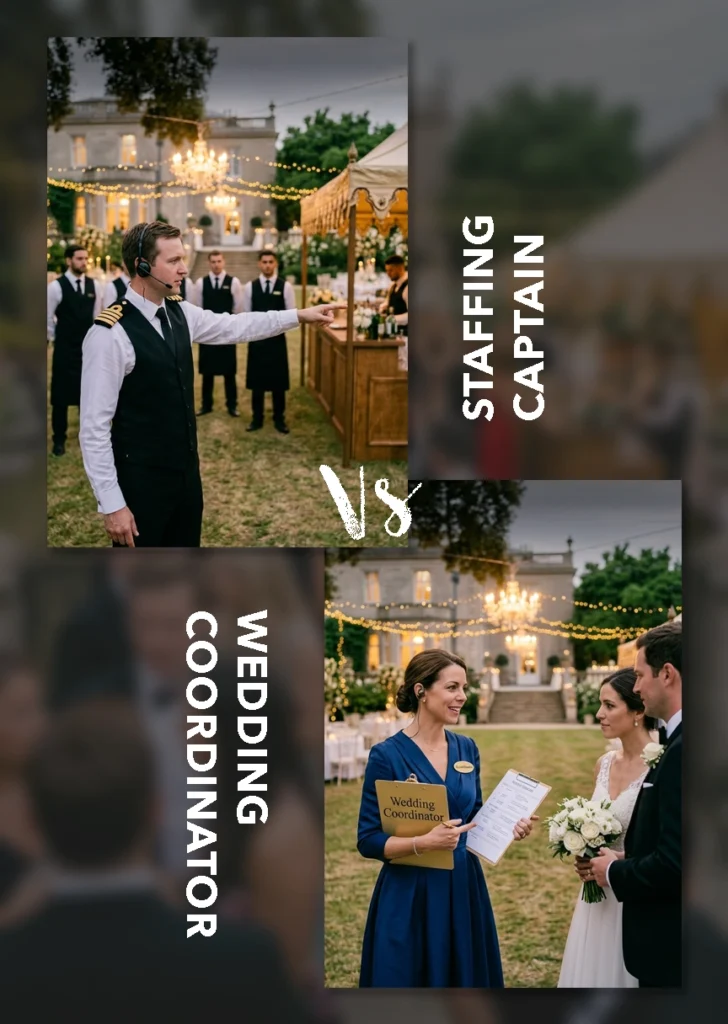
Staffing Captain vs. Wedding Coordinator: Know the Difference...
This is one of the most common points of confusion in wedding planning — and getting it wrong can leave you with gaps on the day of your event.
Your wedding coordinator or planner manages your vendors, your timeline, your ceremony logistics, your seating, and every relationship-based detail of your wedding. They are your advocate and project manager. On the day of the event, they are handling photographer placement, officiant timing, family wrangling, and the hundred small fires that come with producing a wedding.
A staffing captain manages your service team. They direct servers, coordinate course timing with the kitchen, manage the bar team’s flow, handle anything that goes wrong on the floor, and serve as the communication link between your agency’s placed staff and whoever is running the event. A good captain makes your reception feel effortless because every service decision is being managed proactively — not reactively.
These are two different jobs. Your wedding coordinator is not managing the service staff. Your venue coordinator is focused on the venue, not your personal event. Your staffing captain is the person whose entire job is making sure every glass gets refilled, every plate lands on time, and your guests never wait for something they need.
For any reception with more than 75 guests, you need both. Assuming one covers the other is one of the most expensive assumptions you can make at your own wedding.
Five Things That Change Your Staffing Number...
The ratios above are starting points. Here are the factors that push your numbers up — sometimes significantly.
1. Multi-level or multi-room venues.
A reception spread across a main ballroom, a cocktail terrace, and a separate lounge area needs staff coverage at every transition point. You can’t pull your server from the dinner floor to monitor the cocktail terrace. Each space requires its own coverage, and travel time between spaces adds to the workload in ways a single-room event doesn’t.
2. Extended event duration.
Any reception running longer than five to six hours requires staff rotations and break coverage. Your headcount needs to account for the full shift, not just the peak service window. An eight-hour reception with 20 servers on the floor is not the same labor plan as a five-hour reception with 20 servers on the floor.
3. Multiple synchronized service moments.
A champagne toast for 200 guests requires every server on the floor simultaneously for a short, high-intensity window. If your reception includes multiple moments like this — a champagne pour, a cake service, a late-night snack station launch — your staffing plan needs to account for peak demand at each moment, not just average demand across the night.
4. A complex bar menu.
Two batched signature cocktails move faster than custom martinis and espresso martinis made to order. Every additional step in drink preparation slows your bar. If your menu is complex, your bartender ratio needs to tighten — regardless of what your guest count would suggest under a standard formula.
5. VIP or head table service.
Many couples want elevated, more attentive service for the head table, family tables, or specific VIP guests. This requires dedicated staff assigned to those sections — not pulled from the general floor when needed, but positioned there from the start.
When to Book Your Wedding Reception Staff?
For South Florida weddings, the timeline matters more than most couples realize.
The South Florida wedding season runs October through April — which is also when corporate conference season, charity gala season, and the luxury event market are all running simultaneously. The most experienced hospitality professionals in the market are working all of it.
Book 8–10 weeks before your wedding for events during the off-season or shoulder months. This gives your agency enough lead time to identify the right staff, confirm availability, and complete a proper briefing.
Book 10–14 weeks before your wedding for any event between November and April. This is non-negotiable for couples who want experienced, vetted, formally trained service staff at their reception. Waiting until 4–6 weeks out during peak season means choosing from whoever is still available — not the professionals your reception deserves.
A good staffing agency will also ask about your event details before confirming availability — not after. If someone commits to your date without asking about your guest count, service style, or timeline, they’re booking a slot, not building a plan.
Do You Need to Feed Your Event Staff?
Yes — and this comes as a surprise to many couples who aren’t told upfront.
Providing a vendor meal for your event staff is industry standard practice. For a reception running five or more hours, a working meal — separate from your guest menu, usually provided by your caterer or venue — is standard and expected. Most staffing agreements will include a note about vendor meal requirements.
Coordinate this directly with your venue and caterer when confirming your event plan. Your staffing agency should flag it as well. It’s a small detail that, left unaddressed, becomes an awkward conversation on your wedding day.
Ready to Start Planning Your Wedding Staffing?
Noble LG has staffed wedding receptions across South Florida for couples who want their evening to feel effortless — for them and every guest in the room. From intimate plated dinners to large-scale formal receptions, we build staffing plans around your event’s specific format, venue, and service vision.
If you’re in the planning stage and want to understand exactly what your reception requires, we’re happy to walk through it. No commitment required — just an honest conversation about what your evening needs to run the way you’ve imagined it.
Contact Noble LG to start planning your wedding reception staffing today.
Contact Noble LG → Here
Ready to Start Planning Your Wedding Staffing?
Q: How many servers do I need for a 150-person wedding?
A: For a 150-person plated dinner, plan for 13–15 servers, 4–5 bussers, 3–4 bartenders (full open bar), and 1–2 event captains. For buffet service, reduce servers to 6–8 but keep the same bar and captain coverage. Add a greeter if you have escort cards or a formal seating arrangement.
Q: What is the bartender ratio for a wedding reception?
A: For a full open bar with beer, wine, and spirits, plan for 1 bartender per 50 guests. For beer and wine only, 1 per 75 guests. If you’re serving signature cocktails or blended drinks, tighten to 1 per 35 guests. For cocktail hour specifically, plan for 1 per 40–50 guests regardless of your dinner bar setup — this is your highest-demand window.
Q: What is the difference between a staffing captain and a wedding coordinator?
A: A wedding coordinator manages your vendors, ceremony logistics, and overall event timeline. A staffing captain manages your service team on the floor — directing servers, coordinating course timing, and handling any service issues before guests notice. For receptions with 75 or more guests, you need both. They have different jobs and neither one covers the other.
Q: When should I book event staff for a South Florida wedding?
A: Book 8–10 weeks before your wedding during shoulder months. For weddings between November and April — South Florida’s peak season — book 10–14 weeks in advance. The most experienced hospitality professionals in the market are in high demand during this window and commit to their best clients early.
Q: Do I need to provide a meal for my wedding event staff?
A: Yes. Providing a vendor meal for your event staff is standard industry practice, especially for receptions running five hours or more. Coordinate this with your venue and caterer when confirming your event plan, and confirm the requirement with your staffing agency at the time of booking.